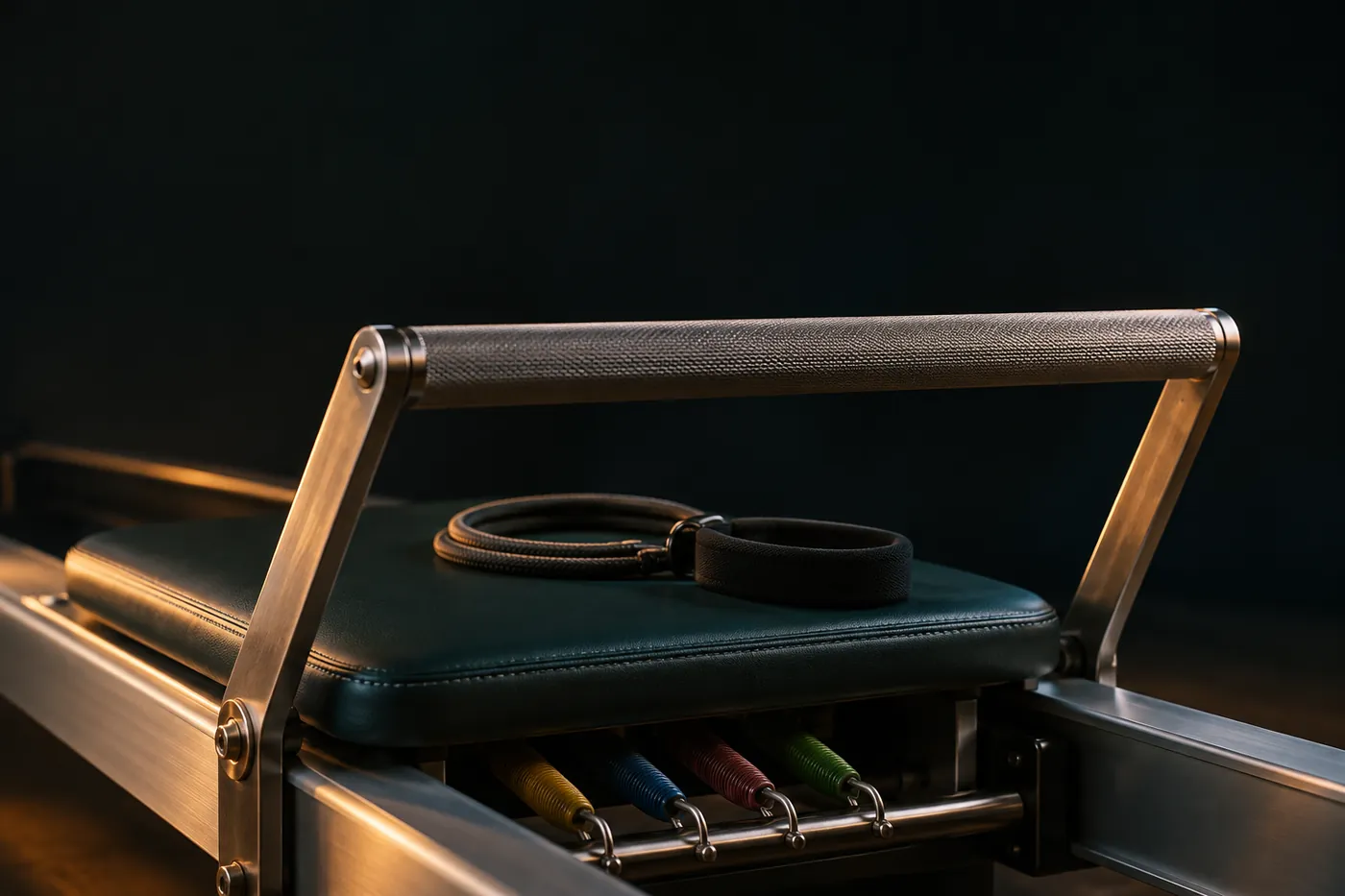
Full travel
The reformer, end to end
A reformer is a frame, a pair of rails and a padded carriage that runs along them against springs. Everything else on it exists to set where the carriage starts, how hard it is drawn home and what you hold or push while it moves.
This page describes the apparatus as a craft. It is not a list of what the studio owns: the makers and the number of machines will be stated when they are on the floor.
From the footbar to the risers
The frame carries two rails, and the carriage runs on wheels along them. At the foot end the carriage comes to rest against the stopper; a gear bar or spring bar there holds the springs, which hook into eyes under the carriage. On many machines the bar sits in notched gear positions that change where the springs start.
At the head end of the carriage are the shoulder rests and the headrest. Beyond them the ropes run over pulleys on the risers and end in straps or loops. When the carriage is home and the straps hang on their hooks, the machine is at rest.
Springs, and why their colours mislead
Each spring on the bar is coloured by its maker, and every maker chose its own colours. The table below sets three makers’ published charts side by side, unnamed and ordered by rung: a spring’s place in its own maker’s range, lightest to heaviest.
A rung is a place in the order, not a measured pull. Some charts also draw each spring’s pull against how far it is stretched, and others give a starting tension and a rate per inch; neither is used here, because the machines in the studio are labelled and set by the instructor on the day.
| Rung | Chart one | Chart two | Chart three |
|---|---|---|---|
| 1, lightest | Yellow | White | Green |
| 2 | Blue | Blue | Blue |
| 3 | Red | Red | Yellow |
| 4, heaviest | Green | Black | Red |
Read from three reformer makers’ own published spring charts. They are not named here because the point is not any one brand: a colour on its own does not name a spring. The colour translator on the studio page turns a setting written for one machine into another machine’s colours.
Footbar, headrest and straps
The footbar
At the foot end, standing upright or lying flat, and on most machines locking at several heights. It is checked before anything else each day: it should hold its position and pivot with resistance, never fall freely.
Headrest and straps
The headrest is raised, flat or lowered to suit the work. The straps or loops on the rope ends hang on their hooks whenever they are not in use, so nobody stands on a rope or catches a loop in the wheels.
Boxes and accessories
- Sitting box, across the carriage
- Long box, along it
- Jump attachment, in place of the footbar
- Platform extender, at the foot end
Each accessory goes on and comes off as a planned change between blocks, never in a hurry mid-block. Where an accessory changes the machine’s set-up, the springs are checked again before anyone steps back on.
The rest of a studio’s apparatus
Beyond the reformer, a Pilates studio may hold a tower or wall unit, the Cadillac or trapeze table with its push-through and roll-down bars, the small Wunda chair with its sprung pedal, and the barrels: the ladder barrel with its short wooden ladder, and the lower, smaller barrels beside it.
Which of these the studio holds depends on the room, and will be said plainly once they are installed. The flexible ring, small balls and bands belong to the mat classes.